Meredith talks about this important strategy as a way to strengthen affinity and loyalty amongst your customers.
We provided some other examples of businesses (aside from The Inside Source) that employ this strategy last week from a product/retail perspective.
We also wanted to share 2 examples of services businesses who take a similar approach.
The ever so talented dog photographer Erin Vey not only provides gorgeous imagery for her followers and clients through her site and blog, she also demystifies the photography experience and provides lots of education for novices who want to take better pictures on their own.
For example, here she shows how she got this terrific shot of my friend Katie and her fabulous dog Hank.
Another woman who creates a fantastic online editorial environment for her service business, is interior designer Kelly Galvin Robson. Her blog, High Street Market and curated Etsy shop of vintage finds both provide interesting, editorial, interactive ways for those interested in her design services and style to create a connection.
FOOD FOR THOUGHT:
* As a service business, what editorial tactics can you employ to increase not only customer stickiness but also your profile in the industry?
* What kind of curated experience can you create for your customers and potential customers?
Today we are talking about new publishing platforms and advertising trends.
How does the Inside Source fit in with other media, publishing, and retail trends?
As traditional media undergoes a major transformation (and let's face it--a shrinking--think of all of your favorite magazines that have folded in the past year!) the door has opened for a new class of publishers to emerge. At the same time, many non-media companies are taking their consumer messaging into their own hands and going directly to the consumer. Given the passionate community around the eBay brand as well as the insights gleaned from the company's shoppers, eBay is in a natural position to take this next step.
Further, because eBay is essentially product agnostic (it's not trying to get rid of inventory or push one brand over another), it's also perhaps a more reliable media source than traditional retailers who might put out catalog-like magazines in a similar vein.
What do you expect to happen in the media and publishing world over the next few years? What can we expect?
The million dollar question! There is a fundamental business model problem in media right now: Advertising is falling tremendously, yet beautiful glossy magazines and TV dramas are expensive to produce. Online advertising is much less expensive, but the quality of the content is often not up to par. These days, anyone can be a producer of content. This is a great thing in many ways, but it also means that it's harder to sift through the rubble for the consumer--and the advertiser (which already has less money to spend) has to make its dollars go even further.
I don't know what the answer is, but I do think we can expect more advertising to move online. Also, as technology develops (first online and soon after on television) that allows advertisers to target specific users based on their past viewing/browsing behavior, publishers will be able to squeeze more out of their advertisers.
What advice do you have for small business owners like us when it comes to media, publishing, and online buzz?
Don't underestimate how large you have to be to make money on the internet through advertising. There are very low barriers to entry to starting a website, which means anyone can do it--and there is a lot of competition out there. For the most part, you have to be huge (at least 1m uniques/month--maybe more) to get real advertisers on your site. You can get google ads and sign up for an ad network, but you won't make much money that way--just pocket change.
You should think about other ways to partner with potential advertisers--perhaps by integrating them cleverly with your content. Or build a very targeted site with a specific advertiser base that wants to reach your audience.
Of course sometimes, a in the case of The Inside Source, a website (or other media entity) is not always about driving direct revenue to a company. Sometimes, it is more about changing brand perception or promoting a particular program. It’s just important to be clear on your goals—and expectations—when you go down the publishing road.
As far as gaining a following...it you build it, they won't necessarily come! So think carefully about your online marketing strategy before you launch.
Earlier this week, I participated with 14 other women entrepreneurs in an incredibly valuable workshop called 'Write to Change the World' put on by The OpEd Project and facilitated by Katie Orenstein and Marci Alboher.
The program aims to "to expand public debate, with an immediate emphasis on enlarging the pool of women experts who are accessing (and accessible to) our nation's key print and online forums—which are a gateway into public debate, feed all other media, and are a hub of thought leadership."
The first interactive exercise, designed by the founder of the organization, Katie Orenstein sounded easy...at first.
Katie simply asked us each to state the following in less than a minute:
Hi, I'm (name) I'm an expert in _________________ Because _______________________
Most of the women in the room struggled with the exercise. In part, because there was a feeling of discomfort in owning the "expert" title.
Many of us brought a sense of humbleness to the exercise and watered down our answer - not wanting to feel like a braggart - not wanting to project a false image. Many of us were not even sure we had the right to define ourselves as an expert.
This led us to a great discussion about what defines an expert. Academic credentials? Personal experience? Professional work experience? Number of clients? Brand name? Third party endorsements? Media accolades and appearances? All of the above?
It was striking to me was that this conversation was occurring as I was sitting around the table with experienced business owners who are not only talented but also clearly experts in their field, and well sought after ones at that.
The exercise helped each of articulate our expertise and understanding how valuable it was to ourselves and our businesses to own the expert identity.
Because, Katie asked us to both spread the word and share our experience, I strongly encourage you to try this exercise!
See if you can craft your response in a manner that is big and genuine and comfortable. For the purposes of this exercise, clear your head of your finely-tuned 15 second pitch (that is a useful, but different tool). Stick to the guidelines. Then own it, and most importantly use it!
A few weeks ago, I posted about CommonCraft, a really cool site that creates 3 minute instructional videos. That post was then followed up by another on HowCast, a user generated site of explanatory videos.
There is clearly a trend here and I really like these little videos – they are cool, short, engaging, and very informative.
So I was very pleased when CEO of Creativity Works, Martin Shovel, shared with my a video that his company made and posted on youtube debunking on of the most popular communication myths around – that the actual words you use are the least important communication vehicle as compared to facial expressions and tone of voice.
I actually remember being taught this myth multiple times in graduate school (as well as later in several professional development workshops) and while in the context of learning about cross-cultural communication the importance of non-verbal communication is critical principle, I found the video’s counterpoint to this common myth to be quite compelling.
The video has received a whopping 6,649 views and has received comments by folks such as Seth Godin and Daniel Pink.
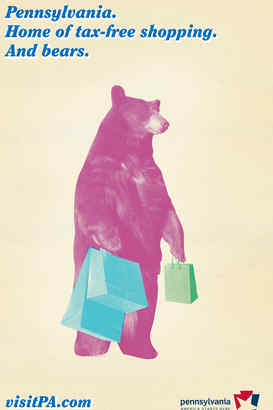
So, I feel a little torn about the debate over one of Pennsylvania’s (my home state) recent tourism marketing campaigns. It seems that the state printed posters for the Tube in London advertising its bears and tax-free shopping. The slogan actually says: Pennsylvania. Home of Bears and Tax-Free Shopping.
I, for one, love the image. It is cute and punctuated with a funny, shopping bear graphic. So what’s the problem? Well, Delaware, our neighbor, is none too pleased as they are officially the State of Tax-Free shopping and many feel like PA’s new campaign is misleading at best.
For clarification purposes, PA does have tax-free shopping on food & clothing (and BTW drugs, textbooks, resale items and residential heating fuels), but not on restaurant tabs for example. And lord knows our state has plenty of bears.
I don't think it is similar to the very negative ones listed in the Inc list, but is this campaign misleading? Or maybe just insensitive to Delaware’s reputation and tourist calling card?
Have you had the experience of another business advertising messages similar to yours? As a business owner have you felt constricted on account of messages, words, or phrases already used by other businesses?
This month Inc Magazine included an article on “Great Marketing Moves”, which features some 30 “classic examples” of ways that entrepreneurs who have little cash but lots of creativity have gotten noticed. The list of examples cites examples as far back as the early 80s.
The list is interesting and many do highlight innovation and creativity but I have to admit that I was surprised by some the examples included. Several were shock value campaigns such as the infamous Go Daddy Super Bowl ads, while others had a strong tone of aggression.
More than specifically competitive, some of the examples are clear taunts to competitors including one that actually unintentionally incited vandalism at Starbucks and another campaign rewarded customers from ripping a Dominos pizza add out of phone books.
Reading this list of example got me wondering how many of these "great marketing" examples I would actually want to use. Some, but certainly not all. I am sure that it isn't that hard to cite 30 great marketing campaigns that are all based on creativity rather than shock or competition. I wonder why some of these examples seemed so impressive?
When I was in graduate school I remember hearing about the marketing campaign of the leading depression drug who wanted to find a way to boost sales that didn’t require the medical laundry list that most commercials mandate. So the company decided to advertise about depression in general. They knew that their promotional efforts would lead to a spike in sales of their drug over other drugs, but rather it would likely lead to an increase in all depression drugs, of which they were already the leading seller. This tactic is a far cry from tearing out competitors’ ads from the phone book.
Reading this also reminded me of a post that I wrote last year on the advertising rules for public radio spots, which prohibit the use of superlatives and force companies to advertise with integrity and focus on qualitative information. Read the quidelines here.
* At the very least this serves as a very helpful exercise...What would your public radio advertisement say?
A few weeks ago a really interesting article by Douglas Quenqua in the NY Times entitled Blogs Falling in an Empty Forest talked about the status of the blogosphere and bloggers today.
The article cited data from Technorati that shows that 95% of all blogs have effectively been abandoned (weren’t updated for more than 120 days).
Why?
Some bloggers never really took off, others got too busy, others felt too exposed and shuttered their blogs in order to regain a shred of privacy, others felt web 2.0 changed the nature of blogging favoring shorter posts versus longer more journal-like styles.
Some had thought their blogs would bring them fame or fortune or both, and left their blogs when those dreams went unrealized. (For more on the money myths of blogging read this article that reports that the average ad blog makes only $5k per year.)
So, with no shortage of blogs and bloggers out there, it seems we are at the next stage of the blogosphere life cycle. Blogging has been around long enough to have grown in awareness then popularity, to have myths built up and exposed, and to shift in the fundamental usage. We are at an evolutionary moment.
Perhaps these people are using less social media overall, or perhaps they are just are abandoning blogs and moving to the more-portable and more immediate facebook or twitter applications.
Perhaps casual users will all move to these other mediums leaving the blogosphere more dedicated writers, story tellers, or information sellers. Perhaps blogs will continue to fill the journalistic space where the print media field dissolved.
Perhaps blogs will just be the new “home base” where all these communication mediums are docked and stored.
Quenqua also quotes Richard Jalichandra of Technorati who said that at any given time there are 7 million to 10 million active blogs on the Internet, but “it’s probably between 50,000 and 100,000 blogs that are generating most of the page views.” He added, “There’s a joke within the blogging community that most blogs have an audience of one.”
This reminded us of a similar report on Twitter. Now obviously Twitter is a newer technology that is by all accounts just taking off, and certainly most people are just getting comfortable with it.
* Among these users the median number of lifetime tweets is one! * & the top 10% of twitter users account for 90% of all the tweets (& interestingly though men and women follow a similar number of people, men tend to have 15% more followers than women)
However, for those that are still eager to start or build a blog (for a larger audience than one) here are some good resources that can help you learn from the ground up - (not that we are speaking as experts here, we know we still have a long way to go!)
ProBlogger: 31 Days to Build a Better Blog (used to be a free email-a-day program and now is a (not-free) e-book. 14,000 bloggers have done the program, which really breaks the gargantuan task down into bites sized chunks.)
Recently two articles have caught my attention. Both seek suggest a new name as a means for rebranding a movement or initiative.
The first in ODE Magazine suggests that the term "green" is played and that a more authentic term for the "green movement" would instead be "brown".
Another, a Newsweek article, notes the increased incidence (especially in the restaurant world) of the term "house-made" and the resulting decline in the term "home-made".
* Are these new names or labels effective?
* What could you rename or reframe in order to be more effective?
* Or to better articulate your purpose or points of distinction?
For example, Cali Yost's company seeks to reframe the public's notion of WorkLife Balance with the name of her company, WorkLife Fit.
In my experience, people like to help others (ok, not everyone, but most people do). Even if they are not “connectors” by nature, when asked a lot of people will make their best effort to help. Perhaps it makes them feel good, hopefully they recognize all the help they have received along their professional journey and feel obliged to pay it forward, perhaps they believe in Karma - whatever the reason, most people really are motivated to help in most matters!
But there is a catch – you need to be very clear about making it known how people can help you or what you need from them.
If you are trying to develop new business and you are taking partners and colleagues out to coffee to connect, be clear about what type of business you are looking for specifically. Often people tell others what they are good at, describe their product or service and assume that their needs / target market is self explanatory. I can assure you they are not! We are so inundated with information that it is hard to remember lots of details – keywords are the way to go.
When I meet someone new and they ask about my business, I want them to walk away knowing that I CONSULT to WOMEN BUSINESS OWNERS and I have a WORKSPACE. If they can remember that – I am golden. What are your Keywords?
Yes, the publishing world is in turmoil. Newspapers and magazines are folding, journalists are shuffling to different positions, and the fate of each print publication seems to be up for debate. I have been admittedly more thoughtful about my magazine subscription renewals after my devastation over losing Domino and Conde Nast’s unwelcome substitution of Glamour in its place, but have continued to renew everything because I really want them to succeed and because I value their content tremendously.
Last week’s issue of Newsweek was an emotional one, I was initially distressed about the departure of Anna Quindlen and then I noticed "Reinventing Newsweek" a piece about the future of Newsweek and upcoming changes to the magazine. Bad news fatigue instantly made me suspicious but I couldn’t have been more pleasantly surprised! The article was written by Kathleen Deveny and was a terrific example of a company-to-customer communication.
Deveny did several things really well including: * acknowledged the reality of the changing publishing industry * restated newsweeks commitment to quality and reporting with integrity * outlined the redesign that is soon to be launched * reported how the changes have been designed to mirror customer feedback (more of this, less of that) * indicated the requisite changes that will accompany the redesign (i.e. higher price, a more targeted audience)
Despite the higher subscription price, I am so pleased with this article. It is a well-articulated business case, which is equal parts reactive and proactive, focused on value, and grounded in strategic decisions. Even if you don’t read or subscribe to Newsweek flag this article as a great example to follow! We have!
Recently, I have been giving thought to the concept of curating and how that applies to small business. Often, what is referred to as “well edited” is really about creating an experience. Tastemakers are those who are naturally endowed with curating and editing talents. They seem to effortlessly be able to cultivate an experience and a following.
It is tastemakers who are tasked with creating so many of the familiar experiences that we enjoy. Think about art, music, movies or fashion.
In art, you go see a show and the work that is selected and hanging on the wall is meant to make a statement. The curator hopes that by looking at the sum of the collection that you will a certain reaction. Editors for movies do the same. They choose from hundreds of hours of footage to piece together a story, so that when it reaches the theater you feel you are “experiencing” it.
Fashion is a classic opportunity to edit – think of your favorite store – it is your favorite because of how the buyer is “curating” the collection. You feel like they “get you and what you like” and you return to see what other things they have found for you.
In essence, curating makes things less overwhelming and allows a business owner to make a statement about who they are, what their business is about, and most importantly it allows them to connect more closely with their customer and cultivate a following. As a business owner, you are seeking a reaction, often in the form of a purchase or a client or repeat business. Your editing will help you attract your clients but also, find your community.
If you sell a product(s), re-examine your collection to see if it is well edited. Does it make sense to the consumer? Is it overwhelming and impacting your ability to close a sale?
If you have a service business, is your service offering clear? Do you offer too many services which are not “well edited” and may confuse your potential customer?
In either case, are you curating the experience you want your customer to experience? If the answer is no, then start editing!
Thanks to the state of the economy we are all inundated with recession specials and discount pricing. In fact, many of us are loathe to buy something that ISN’T on sale. However, a new study from Stanford Business School entitled “The Time vs. Money Effect” learns that pitches that focus on the value of time are far attractive, enticing, and appealing than those that focus on money. The study, detail in the Wall Street Journal Article, Why Tie Marketing to Time Not Money, also seems to indicate that even post-purchase, consumers report about their belongings more favorably when prompted to consider their time and experience with the item rather than the value or monetary investment associated. This finding certainly seems worth taking into account when rethinking your marketing messages, pitch language, and promotions!
If there is any advice to be given for 2009 it is to BE VISIBLE. It is so imperative in this uncertain economy to remain on the on the radar of your existing clients and potential clients. As people are taking a “trimming the fat” approach to business expenses and are being much more cautious about business investments, you want to make sure that you are not one of the casualties. How do you do that? Make sure that customer service is a major priority. Make sure that you are doing all that you can for your clients. Check in with them and see if there is any way that you can be of more help. In lieu of sending a “thanks for being a customer” note, demonstrate that through your actions.
If companies have put projects on hold, you want to keep the dialog going. Maintain your connection so that when they restart the project, they will choose you as the vendor. DO NOT DISSAPEAR.
We encourage you to be creative about how to stay on the radar. Send your clients articles that you believe are relevant and interesting to them. If you are a social networker, make sure to send updates about recent successes and current projects.
In addition, we cannot emphasize how important the "in-person" is, both for making new connections as well as strengthening existing ones. Nothing replaces the face-to-face meeting. While people have relied on online tools (social networks, email) to keep connected, we suggest that those techniques supplement in person connectivity.
Now is the time to go to conferences, events and strategic networking meetings.
Now stop reading this blog and go out an meet a client or colleague in person!
I was recently looking at the corporate underwriting (advertising) opportunities on my local NPR station - WHYY in Philadelphia and was struck by their submission guidelines.
They permit your "spot" to include the following: • Names of products or services • Non-promotional, value-neutral description of products or services • Company location and number of years in business • Telephone number, e-mail address or Web site address
They DO NOT permit: • Comparative or qualitative descriptions of products or services • Superlatives (e.g. "best" or "biggest") • Price references, even if the product or service is free • Calls to action or inducements to buy • Third party endorsements from newspapers, magazines, etc. HOW REFRESHING!!!
No wonder their advertisements aren't so annoying to hear!
No wonder I have such a positive image of many of their sponsors (even though I may have no direct experience as a consumer of many of these businesses and organizations).
What if all advertising had this much integrity?
Can people be just as effective without grandiose claims or negative digs?
(ps, both political campaigns could have received some good counsel from this policy.)
I have heard the conventional wisdom that supports the stating of numbers, the cattle call of achievements, heightened sense of urgency, and the slighting of others as effective advertising tools.
However, in most cases, I have to disagree.
I think the NPR kind of guidelines instead make you focus more closely on articulating your value proposition and underlying goal.
What your business does and why is then left to stand on its own, uncluttered by boisterous empty phrases.
Devoid of gimmicky language or sales-y speak, this kind of advertising forces a genuine and candid exchange between you and the consumer, mano a mano, as they say.
It makes you think....
* What would your NPR ad say? * Would this position your company strongly? * Would you be confident in your message?
Starting this fall, we have decided to focus on a particular theme each month and reach out to our fabulous community for their thoughts, ideas, experiences and stories about those topics. Since many of us are experiencing the 'back to work' mentality that the end of summer often brings, and many of us are thinking about Q4 numbers as we stare down the end of the year, we decided that September's focus should be innovative ways to land or "catch" clients.
Here are a few of the stories that our members have shared with us: Lynn Berry, Field Manager of Atlantis Health Plan (646-421-8717) stood outside the Union Square movie theater while "Sicko" was playing, handing out flyers and wearing a backpack sign. A man and his two boys stopped to talk, and she ultimately signed up the family.
Sarah Leah Gootnick, Founder Secretary in Israel LLC considered ALL of her connections and resources when looking for new business. "When I launched my business I sent an email to my Rabbi asking him if he would email his synagogue about our virtual assistants. I got an unexpected email back from him letting me know that he needed a virtual assistant for his congregation! Not only has that worked out great, but he introduced me to some of his other Rabbi colleagues, too. So you just never know who might be a potential new client!"
Galia Gichon, Founder of Down-to-Earth Finance was trying to reach a few strategic large organizations to present seminars to their employees. She didn't have any contacts so she cold called them. When she reached one Executive Director, she was not able to bring Galia in on to present seminars at her organization BUT she signed up for my individual services right away! A few years later, the Executive Director brought Galia in to present seminars to the organization!
Christine Janssen, denken Research & Consulting just developed and launched "The Recession Special" to enable entrepreneurs to keep moving forward with their businesses despite the crazy economy. She is offering 25% off all of her services during September and October, plus if you refer a new client to Chris during that same time period and they also subscribe to her services - you will BOTH get 30% off any services that commence between Sep 1 and Oct 31!
Well, Amy met delightful IGC member Dages of Delicious Dialogues at a sample sale last August. And we also recently began working with a fantastic video producer who was tasked with shooting IGC for a clip on Current TV (yet to be aired). Another of our members, Christine Courtney of C3 Agency, represented the drink sponsor for the launch of Galia Gichon's My Money Kit.
Moral of the story? Shop and go to sample sales. Well, more to the point...be open to meeting people and talking about your business whereever you go. You never know where new clients may maternialize but resourcefulness, creativity and persistance can pay off! So, think about what creative outlets YOU can use to find your next client.
We are Adelaide Lancaster and Amy Abrams. We run a community and workspace for women entrepreneurs in NYC. This blog helps us share interesting news on small business ideas, models, resources, and innovation with our members and other entrepreneurs.






 Posts

